

RELEVANT INFORMATION
Self-Neglect and Hoarding Procedure
MARM, PREP & Self Neglect (opens in Buckinghamshire Safeguarding Adults Board website)
September 2026: This new policy, aligns with the duties outlined in the Care Act 2014 and the Care and Support Statutory Guidance. It should be consulted when an adult at risk is suspected of self-neglecting and/or hoarding.
CONTENTS
1. Introduction
This policy, produced by the Buckinghamshire Adult Safeguarding Partnership, aligns with the duties outlined in the Care Act 2014 and the Care and Support Statutory Guidance. It should be consulted when an adult at risk is suspected of self-neglecting and/or hoarding.
Addressing self-neglect is one of the most challenging aspects of practice, primarily because it often intersects with personal choice, including hoarding behaviour. This dynamic creates a tension between the fundamental aim of safeguarding—reducing risk and implementing Making Safeguarding Personal (MSP)—and respecting an individual’s autonomy.
Individuals who experience self-neglect may inadvertently put themselves and others at risk, such as creating fire hazards. Striking a balance between protecting these adults and honouring their right to self-determination is a significant challenge for service providers. Working with individuals who are difficult to engage can be exceptionally time-consuming and stressful for everyone involved. Nevertheless, failing to engage with those who neglect their own care, regardless of their mental capacity, can have serious consequences for their health and well-being and can also affect their families and the wider community
This policy is informed by relevant research on effective support for individuals who self-neglect. It aims to enhance the well-being of these individuals and reduce the risk of harm by delineating the principles that all staff and organisations should adhere to.
2. Purpose
The policy aims to prevent serious harm or even death of individuals who appear to be self-neglecting by ensuring that:
- individuals are empowered, as much as possible, to understand the implications of their actions;
- there is understanding and recognition of the complexities involved in working with self-neglecting individuals;
- effective work and practice are promoted;
- concerns are appropriately prioritised;
- organisations uphold their duty of care; and
- responses are proportionate to the levels of risk to self and others.
3. Scope
This policy is intended for professionals working with individuals who may engage in self-neglect.
It does not address risks related to intentional self-harm. If self-harm seems to result from neglect or inaction by another person or service, it may be necessary to report the situation to Adult Social Care as a safeguarding concern.
4. What is Self-Neglect and Hoarding?
Self-neglect can describe a wide range of situations or behaviours experienced by a person. Each circumstance is unique. It could be someone whose personal care or health is deteriorating due to a lack of attention, or where they are not maintaining their home environment for so long that it becomes overly muddled or dirty, and therefore unsafe to their health or the wellbeing of others.
The Care and Support Statutory Guidance defines self-neglect as:
“…..covers a wide range of behaviour neglecting to care for one’s personal hygiene, health or surroundings and includes behaviour such as hoarding“.
The term itself can be a barrier to working with the issues, and some individuals do not identify with this term or description of their situation. As a result, it is important that practitioners seek to negotiate a common ground to understand the individual’s own description of their lifestyle rather than making possibly discriminatory value judgements or assumptions about how it can be defined.
4.1 Signs of self-neglect
- extremely unclean living conditions, potentially accompanied by signs of pest infestation;
- ignoring household upkeep, leading to fire hazards or safety risks, such as malfunctioning boilers or hazardous electrical systems;
- hoarding items to an extent that it poses environmental or health dangers;
- poor personal hygiene and health deterioration due to untreated medical conditions, exemplified by an unkempt appearance, overgrown nails, pressure sores, malnutrition, or dehydration. This also includes missing critical medical appointments;
- refusing prescribed medications or not adhering to the advice of healthcare and social services;
- residing with numerous animals in unsafe living conditions;
- experiencing financial difficulties, such as accumulating debt that could result in rent arrears or eviction;
- mismanaging finances by prioritising the purchase of alcohol or substances over essentials like food and utility payments;
- living in excessively cluttered spaces that present fire hazards and obstruct access;
- engaging in substance or alcohol use to a harmful or risky degree.
Please note: This list is not exhaustive.
4.2 Hoarding
Hoarding is one common aspect of self-neglect and typically involves the excessive collection and retention of any material to the point that this has a significant negative impact on the wellbeing of the person.
Hoarding is a complex mental health condition characterised by the persistent difficulty in discarding or parting with possessions, regardless of their actual value. This behaviour often leads to the accumulation of a large number of items, filling up living spaces to the point where they become unusable.
Hoarding is not just about collecting items; it is an overwhelming compulsion to save things. Individuals with hoarding disorder often feel a strong attachment to their possessions and experience significant distress at the thought of losing them. This can result in living environments that are cluttered to the extent that they are unsafe or unsanitary.
Hoarding is recognised as a mental disorder and is defined as ‘involving a persistent difficulty discarding or parting with possessions because of a perceived need to save them’. A person with hoarding disorder experiences distress at the thought of getting rid of the items. Hoarding involves the accumulation of items, regardless of actual value. The hazard presented by hoarding will depend on the type of items retained; for example, the presence of food stuffs, food packaging, urine, faeces, rodent droppings and other putrescible waste will significantly increase the risk of infection and rodent infestations.
Hoarding often creates such cramped living conditions that homes may be filled to capacity, with only narrow pathways winding through stacks of clutter. Countertops, sinks, stoves, desks, stairways and virtually all other surfaces may be piled up with stuff. The clutter may spread to the garage, vehicles, garden and other storage facilities.
The presence of hoarding in itself may also be an indicator that there are other more significant disrepair issues in the home that are being neglected but have not yet been identified.
Hoarding ranges from mild to severe. In some cases, hoarding may not have much impact on a person’s life, while in other cases it seriously affects their functioning on a daily basis.
People with hoarding disorder may not see it as a problem, making intervention challenging.
5. Key Principles
Everyone should be aware of the six principles that underpin the Care Act 2014 pertaining to all safeguarding practice in Buckinghamshire, Throughout this policy we will consider how the principles are embedded when supporting people who affected by self-neglect. The following principles will be adhered to in any work regarding self-neglect and hoarding:
| Principle | Description | In practice this means |
| Empowerment | Presumption of person led decisions and informed consent. | Having clear and accessible systems for adult’s views to be heard and influence change.
Giving people relevant information and support about self-neglect and safeguarding and the choices available to them to ensure their own safety. |
| Prevention | It is better to take action before harm occurs. | Raising awareness about neglect, hoarding including how to recognise and report it. |
| Proportionality | The least intrusive response appropriate to the risk presented. | The adult is at the centre of all responses to concern and any action taken is based on their preferred outcomes or best interests.
An approach of positive risk taking in which the adult at risk is fully involved. |
| Protection | Support and representation for those in greatest need. | Consideration of mental capacity is part of the process, and where people lack capacity decisions are always made in their best interests. |
| Partnership | Local solutions by working with communities.
Communities have a part to play in preventing, detecting and reporting neglect. |
Information is shared between organisations in a way that reflects its personal and sensitive nature. |
6. Prevention
In most cases of self-neglect/hoarding, early intervention and preventative measures can eliminate the need for safeguarding adult procedures.
The Care Act emphasises the importance of using community support networks and facilities available locally. These networks can include family, friends, statutory agencies, and non-statutory agencies already known to the individual. It is crucial to consider all possible interventions and work with the individual over time, allowing them to make decisions for themselves as much as possible. If they are unable to do so, the Mental Capacity Act 2005 also provides a framework for intervention.
7. Multi-Agency Approach
A multi-agency approach regarding self-neglect and hoarding intervention in Buckinghamshire is, as laid out in this policy, a multiagency responsibility.
All partners and organisations within the Buckinghamshire Adults Safeguarding Partnership membership have collective responsibility for the duties set out in this policy.
The Buckinghamshire Adults Safeguarding Partnership has identified that responding to self-neglect is a multi-agency priority and there is an expectation that:
- in line with Section 6 and 7 Care Act 2014, all partner agencies will engage and cooperate when this is requested by the lead agency as appropriate or required;
- where an agency is the lead agency depending on the circumstances of each case, they take responsibility for coordinating multi-agency partnership working;
- all partner agencies will maintain a robust data information system with regards to self-neglect, with the aim that this should inform service delivery, justify decisions taken, identify trends and gaps, identify the need for resources and a tool to benchmark trends/practice.
All partners and organisations will ensure the following when working with people who self-neglect:
- the six Safeguarding Principles are adhered to; Empowerment, Prevention, Protection, Proportionality, Partnership and Accountability;
- the Making Safeguarding Personal approach is used;
- individuals are empowered as far as possible, to understand the implications of their actions and/or behaviours;
- there is a shared, multi-agency understanding and recognition of the issues including those involved in working with individuals who self-neglect;
- there is effective multi-agency working and practice and concerns receive appropriate prioritisation;
- that all agencies and organisations uphold their duties of care;
- there is a proportionate response to the level of risk to self and others;
- The Self neglect and Hoarding Pathway (see Section 9) is applied where relevant.
Organisations may develop specific guidelines for their staff supporting individuals who self-neglect. Any such guidelines must align with this policy and incorporate relevant national research-based guidance.
8. Multi Agency Risk Assessment Framework Approach
See also MARM, PREP & Self Neglect (opens in Buckinghamshire Safeguarding Adults Board website)
Given the complex nature of self-neglect, responses by a range of organisations are likely to be more effective than a single agency response, and a coordinated approach is therefore essential. Multi-agency frameworks are often the best way to ensure effective information sharing and communication, and a shared responsibility for assessing risks and agreeing on an action plan. It is important to be familiar with the multi-agency risk management approach (MARM)
Multi-agency working may be the best approach where:
- an adult has been identified as potentially self-neglecting;
- is refusing support; and
- by refusing support is placing themselves or others at risk of significant harm.
In potentially complex situations or where there is thought to be significant risk to the person’s health, wellbeing, or environment or to others, professionals should use the multi-agency risk assessment tool to evaluate the risks. Where required, it is important to consider individuals’ preferences, histories, circumstances, and lifestyles to achieve a proportionate and reasonable tolerance of acceptable risks.
Where professionals are unable to implement support or reduce risk significantly, the reasons for this will be fully recorded and maintained on the adult’s file, with a full record of the efforts and actions taken. There may come a point where all options have been exhausted and no further interventions can be planned. In these cases, mechanisms must be in place to monitor the ongoing risks with robust contingency plans to manage any escalation of risk.
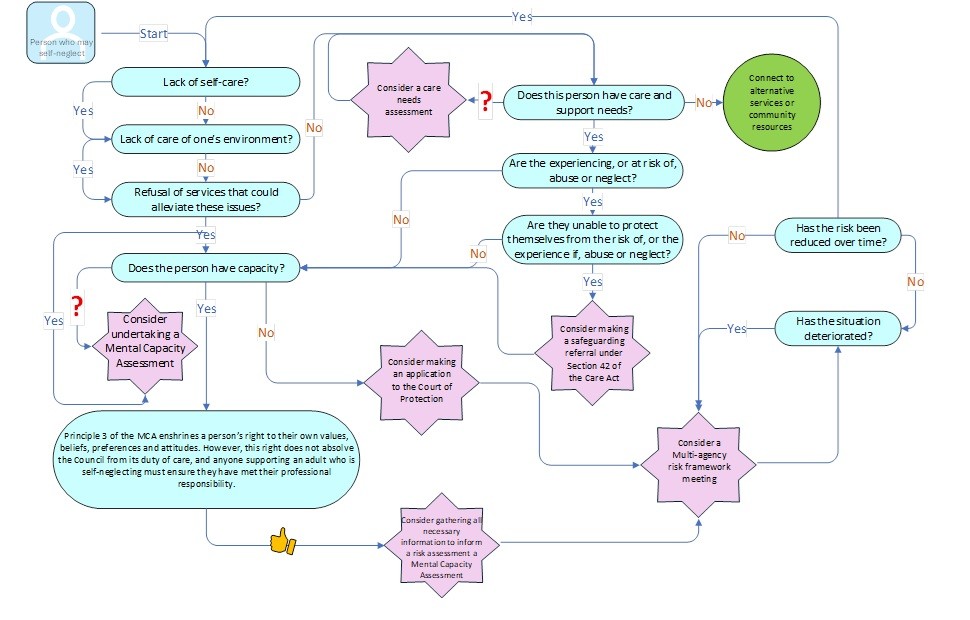
9. Self-Neglect and Hoarding Pathway
The Self-Neglect and Hoarding Pathway has been implemented to provide a structured and coordinated approach for addressing complex cases of self-neglect and hoarding. Recognising the multifaceted nature of self-neglect, this pathway ensures that responses by various organisations are integrated and effective, rather than isolated and fragmented.
One of the key benefits of this pathway is its emphasis on multi-agency collaboration. By bringing together different organisations and professionals, it facilitates comprehensive risk assessments, information sharing, and the development of a unified action plan. This collective approach not only enhances the understanding of the individual’s needs and circumstances but also promotes shared responsibility in delivering support.
Additionally, the pathway encourages a person-centred approach, which is crucial for considering the individual’s preferences, histories, and lifestyles. This helps in achieving a reasonable balance between respecting the person’s autonomy and managing potential risks. The pathway also provides mechanisms for continuous monitoring and contingency planning, ensuring that any escalation of risk is promptly addressed.
Overall, the Self-Neglect and Hoarding Pathway aims to improve the quality of care and support for individuals experiencing self-neglect, thus safeguarding their wellbeing while respecting their individuality and choices.
The following self-neglect and hoarding pathway provides a clear outline of the approach to take when considering self/neglect and hoarding.
10. Legal Framework
The Care Act 2014 recognises self-neglect as a form of abuse and mandates that agencies must collaborate to address it. The Act prioritises early intervention and preventive measures to reduce risks and harm.
A key element of the Care Act is the wellbeing principle, which emphasises person-centred and outcome-focused decisions. These principles are vital in addressing self-neglect cases.
Under Section 42, a safeguarding enquiry is required when an individual who is self-neglecting meets three criteria:
- they have care and support needs (regardless of whether these needs are being met by the local authority);
- they are experiencing or at risk of abuse or neglect; and
- due to their care and support needs, they are unable to protect themselves from abuse or neglect.
The Care and Support Statutory Guidance specifies that self-neglect might not always trigger a Section 42 enquiry. Each case should be assessed individually, and the decision to respond under safeguarding depends on the adult’s capability to protect themselves by managing their own behaviour. External support may become necessary if they reach a point where self-control is insufficient.
Section 42 enquiries are primarily intended for adults facing abuse, harm, neglect, or exploitation from others. Local authorities also have the discretion to conduct non-statutory safeguarding enquiries if it is deemed proportionate and beneficial to the individual’s well-being, supporting a preventive approach. Lower-risk situations, including those involving adults not previously known to Adult Social Care or not receiving health and social care services, may be managed through alternative mechanisms such as:
- engaging the adult in a Care Act assessment;
- signposting to alternative services or community resources;
- arranging for mental health services and support; or
- contact with the GP.
Indicators of significant risk may include:
- history of crisis incidents with life-threatening consequences;
- high risk to others, such as risks associated with substance misuse or fire hazards linked to hoarding;
- high volume of referrals received;
- risk of domestic abuse;
- fluctuating mental capacity;
- history of safeguarding concerns or vulnerability to exploitation;
- financial hardship, including threats to tenancy or home security;
- potential fire hazards;
- public order issues, such as antisocial behaviour, hate crime, and petty crime offences;
- unpredictable or chronic health conditions due to non-compliance with treatment;
- history of chaotic lifestyle, including significant substance misuse or self-harm;
- high-risk environments, such as those with inadequate plumbing, washing, or toileting facilities;
- history of non-engagement with services;
- lack of an informal support network, leading to social isolation.
Additionally, there exists a comprehensive array of legal frameworks and legislation pertinent to situations of self-neglect and hoarding, as demonstrated in the subsequent table.
| Agency | Legal power and action | Circumstances / further information |
| Environmental Health | Power of entry / Warrant (Section 287 Public Health Act)
Gain entry for examination / execution of necessary work required under Public Health Act. Police attendance required for forced entry. |
Non-engagement of person. To gain entry for examination / execution of necessary work (all tenures including leaseholders / freeholders). |
| Environmental Health | Power of entry / Warrant
(Public Health Act 1936 and 1961)
|
Non-engagement of person / entry previously denied. To survey and examine (all tenures including leaseholders / freeholders). |
| Environmental Health | Public Health (Control of Disease) Act 1984 Section 46 sets out restrictions to control the spread of disease, including use of infected premises, articles and actions that can be taken regarding infectious persons. | |
| Environmental Health | Prevention of Damage by Pests Act 1949
Local authorities have a duty to act against occupiers of premises where there is evidence of rats or mice. |
|
| Environmental Health | Enforcement Notice (Section 83 Public Health Act 1936) | Filthy or unwholesome condition of premises (articles requiring cleansing or destruction). Prevention of injury or danger to person served.
(All tenures including leaseholders / freeholders / empty properties). |
| Environmental Health | Litter Clearing Notice
(Section 92a Environmental Protection Act 1990) Environmental Health to make an assessment to see if this option is the most suitable. |
Where land open to air is defaced by refuse which is detrimental to the amenity of the locality. An example would be where hoarding has spilled over into a garden area. |
| Environmental Health | Environmental Protection Act 1990 Abatement
Abatement notice where any premise is in such a state as to be prejudicial to health or a nuisance (Sections 79 / 80). |
|
| Fire and Rescue | Regulatory Reform (Fire Safety) Order 2005 The fire service can serve a prohibition or restriction notice to an occupier or owner which will take immediate effect. This can apply to single private dwellings where the criteria of risk to relevant persons apply. | |
| Police | Power of Entry (Section 17 Police and Criminal Evidence Act)
Person inside the property is not responding to outside contact and there is evidence of danger. |
Information that someone inside the premises was ill or injured and the police would need to gain entry. |
| Housing | Anti-Social Behaviour, Crime and Policing Act 2014
A civil injunction can be obtained from the County Court if the court is satisfied that the person against whom the injunction is sought has engaged or threatens to engage in anti-social behaviour, or if the court considers it just and convenient to grant the injunction for the purpose of preventing the person from engaging in anti-social behaviour. |
Conduct by the tenant which is capable of causing housing-related nuisance or annoyance to any person. ‘Housing- related’ means directly or indirectly relating to the housing management functions of a housing provider or a local authority. |
| Housing | Housing Act 2004
This allows enforcement action where either a category 1 or category 2 hazard exists in any building or land posing a risk of harm to the health or safety of any actual or potential occupier or any dwelling or house in multiple occupation (HMO). These powers range from serving an improvement notice, taking emergency remedial action, to the making of a demolition order. |
The courses of action available to authorities as regards either category of hazard are:
1. Serve an Improvement Notice requiring remedial works. 2. Make a Prohibition Order to close the whole or part of a dwelling or to restrict the number of permitted occupants. 3. Take emergency action. 4. Serve a Hazard Awareness Notice. 5. Make a Demolition Order. 6. Declare a Clearance Area. |
| Housing | Housing Act 1985 and Housing Act 1988
In extreme cases, a landlord can take action for possession of the property for breach of a person’s tenancy agreement, where a tenant fails to comply with the obligation to maintain the property and its environment to a reasonable standard. This would either be under Ground 1, Schedule 2 of the Housing Act 1985 (secure tenancies) or Ground 12, Schedule 2 of the Housing Act 1988 (assured tenancies). The tenant is responsible for the behaviour of everyone who is authorised to enter the property. |
|
| Town and Country Planning | Town and Country Planning Acts provide the power to seek orders for repairs to privately owned dwellings and where necessary compulsory purchase orders. | |
| Mental Health Service | Mental Health Act 1983, Section 135(1)
Provides for a police officer to enter a private premises, if need be by force, to search for and, if thought fit, remove a person to a place of safety if certain criteria are met. The police officer must be accompanied by an Approved Mental Health Professional (AMHP) and a doctor. NB A place of safety is usually the mental health unit but can be the Emergency Department of a general hospital, or anywhere willing to act as such. |
Evidence must be laid before a magistrate by an AMHP that there is reasonable cause to believe that a person is suffering from mental disorder, and is being:
NB Section 135 lasts 72 hours and is for the purpose of removing a person to a place of safety with a view to the making of an assessment regarding whether Section 2 or 3, or 7 of the Mental Health Act should be applied. |
| Mental Health Service | Mental Health Act 1983, Section 2 and 3
Where a person has a mental disorder (as defined under the Act) of such a degree, and it is considered necessary for the patient’s health and safety or for the protection of others, they may be compulsorily admitted to hospital and detained there under Section 2 for assessment for 28 days. Section 3 enables such a patient to be compulsorily admitted for treatment for up to 6 months, this can then be renewed for a further 6 months and then yearly if necessary. |
There must be two recommendations from s12 approved registered medical practitioners. The AMHP makes the application if it is considered appropriate and the less restrictive option. |
| Mental Health Service | Mental Health Act 1983, Section 7
A Guardianship Order may be applied for where a person suffers from a mental disorder, the nature or degree of which warrants their reception into Guardianship (and it is necessary in the interests of the welfare of the patient or for the protection of other persons). The person named as the Guardian may be either a local social services authority or any applicant. A Guardianship Order confers upon the named Guardian the power to require the patient to reside at a place specified by them; the power to require the patient to attend at places and times so specified for the purpose of medical treatment, occupation, education or training; and the power to require access to the patient to be given, at any place where the patient is residing, to any registered medical practitioner, approved mental health professional or other person so specified. |
There is a requirement that any application is made upon the recommendations of two registered medical practitioners. |
| Mental Health Service | Mental Health Act 1983, Section 136
Section 136 allows police officers to remove adults who appear to be “suffering from mental disorder and in immediate need of care and control” from a public place to a place of safety for up to 24 hours and extended for no longer than a further 12 hours for specified purposes. The place of safety could be a police station or hospital. |
|
| All | The Animal Welfare Act 2006 places a duty of care on the person to look after an animal’s welfare as well as ensure that it does not suffer. | This applies to all animals. If there is a concern, report it to the RSPCA on 0300 1234 999. |
| All | Mental Capacity Act 2005
A decision can be made as to whether a person lacks the mental capacity to make specific decisions. If a person lacks capacity regarding a specific decision, any decision made must be in the person’s best interests. It is important to follow the empowering principles of the Act and ensure that any actions taken are the less restrictive option available. |
A person who lacks capacity to make decisions about their care needs, and they are refusing support and at high risk of serious harm to self as a result. |
| Local authority | Building Act 1984 Section 76 is available to deal with any premises which are in such a state as to be prejudicial to health. It provides an expedited procedure ie. the local authority may undertake works after 9 days unless the owner or occupier states an intention to undertake the works within 7 days. | There is no right of appeal and no penalty for non-compliance. |
| Mental Health Service | Community Treatment Orders (CTOs)
If a person has been in hospital under Section 3 or other treatment order of the Mental Health Act, a responsible clinician (usually a psychiatrist) can arrange for a person to have a Community Treatment Order (CTO). This means the person will have supervised treatment when they leave hospital. The person will need to follow the conditions of a CTO. The conditions aim to make sure the person gets the appropriate treatment and can also be used to try to protect the person from harming themselves or other people. Conditions can include where the person will live or where they will go to get treatment. A person can be brought back to hospital if they breach the conditions of their CTO. |
Human Rights Act 1998
Public bodies have a positive obligation under the European Convention on Human Rights (ECHR, incorporated into the Human Rights Act 1998 in the UK) to protect the rights of the individual. In cases of self-neglect, articles 5 (right to liberty and security) and 8 (right to private and family life) of the ECHR are of particular importance.
These are not absolute rights, ie. they can be overridden in certain circumstances. However, any infringement of these rights must be lawful and proportionate, which means that all interventions undertaken must take these rights into consideration. For example, any removal of a person from their home which does not follow a legal process (eg. under the Mental Capacity or Mental Health Acts) is unlawful and would be challengeable in the Courts.
Inherent jurisdiction of the High Court
The inherent jurisdiction of the High Court can be used to protect people who have the mental capacity to make decisions, but cannot exercise that capacity freely because they are:
- under constraint, or
- subject to coercion or undue influence.
Court of Protection
If the individual has mental capacity, the Court has no jurisdiction over that matter.
The Court must first determine whether the person has the mental capacity to decide on a specific matter, and then, decide what is in the individual’s best interests.
The Court of Protection makes decisions on matters relating to property and finance or health and welfare for people who lack the mental capacity to make a specific decision at a specific time.
11. Data protection
Decisions should be mindful of the following principles set out in the Human Rights Act (1998):
Article 8 – right to respect for private and family life. This is a qualified right and can be overridden by the state for lawful and legitimate aims
Decisions about sharing of information must be made in accordance with the Data Protection Act 2018. Data Protection should not be used as a barrier to prevent access or sharing of information. Its purpose is to set out a framework to ensure information is handled securely, safely and used for a specific purpose/objective.
Good information sharing is essential in working with people who self-neglect. The Data Protection Act 2018 contains UK GDPR and retains much of the 1998 Act relating to information sharing.
However, while the UK GDPR places greater emphasis on the need to justify the rationale for retaining personal information, organisations will remain compliant as long as they are able to demonstrate why it is necessary to keep this information for safeguarding purposes as long as the lawful basis for holding this information remains.
12. Training Statement
All managers and organisations have a responsibility to ensure their knowledge and comprehension of this policy and that of their teams remain current to assure appropriate levels of action are fully embedded and effectively practised.